In the heart of the Piedmont region, Fort Mill residents know that a reliable ceiling fan is more than just a decorative fixture—it is a survival tool for the humid South Carolina summers. Whether you are trying to circulate air in a cozy sunroom in Tega Cay or looking to add a statement piece to a vaulted great room in Massey, the right ceiling fan can significantly improve comfort and reduce your reliance on air conditioning. However, with thousands of styles and technical specifications on the market, choosing the “right” one involves more than just picking a pretty design.
Selecting a ceiling fan requires a balance of physics, electrical safety, and interior design. From calculating the ideal blade span for your square footage to understanding the nuances of CFM (Cubic Feet per Minute) airflow, every decision impacts how effectively the unit will cool your space. In this guide, we will break down the essential factors for choosing the perfect fan for your Fort Mill home, ensuring you get the most out of your investment while keeping your energy bills in check.
Table of Contents
Step 1: Determining the Correct Blade Span for Your Room
The most critical factor in fan performance is the blade span (the diameter of the circle the blades make). A fan that is too small for a room will have to run at high speeds constantly, creating noise without effective cooling. Conversely, a fan that is too large can create an overwhelming “wind tunnel” effect in a small space.
Guidelines for Fort Mill Homeowners:
- Small Rooms (up to 75 sq. ft.): Think laundry rooms or small walk-in closets. Look for a blade span of 29 to 36 inches.
- Medium Rooms (76 – 144 sq. ft.): Standard bedrooms or home offices. A span of 42 to 44 inches is ideal.
- Large Rooms (144 – 225 sq. ft.): Master bedrooms or standard living areas. Look for 50 to 54 inches.
- Great Rooms (over 225 sq. ft.): Open-concept living areas common in newer Fort Mill developments. You will need a span of 60 inches or larger, or potentially multiple fans.
Step 2: Matching the Fan to Your Ceiling Height
The height of your ceiling dictates the type of mount you need. For optimal airflow, fan blades should ideally be 8 to 9 feet above the floor.
Flush Mount (Hugger) Fans
If your home has standard 8-foot ceilings (common in many older Fort Mill ranches), a flush mount fan is necessary. These sit close to the ceiling to ensure you have at least 7 feet of clearance for safety.
Downrod Extensions
For the high, vaulted ceilings often found in Baxter Village or Springfield estates, a downrod is essential. A downrod brings the fan closer to the living space. Without one, the air circulation stays trapped near the ceiling, leaving the people below feeling no benefit.
- 9-foot ceiling: Use a 6-inch downrod.
- 10-foot ceiling: Use a 12-inch downrod.
- 12-foot or higher: A 24-inch or longer downrod is required to pull that cool air down effectively.
Warning: If you smell burning plastic or fishy odors near an outlet, shut off the power immediately and call an electrician. This is a sign of melting insulation.
Step 3: Understanding Airflow and CFM Ratings
When shopping for a ceiling fan, ignore the price tag for a moment and look at the CFM (Cubic Feet per Minute). This rating tells you exactly how much air the fan moves.
- 4,000 to 5,000 CFM: Good for standard bedrooms.
- 5,000 to 6,000 CFM: Ideal for medium to large living areas.
- 6,000+ CFM: Necessary for high-ceiling great rooms or outdoor patios.
High CFM doesn’t necessarily mean high wind speed; it means a higher volume of air is being circulated, which is what creates that “wind chill” effect on your skin that makes you feel 6-8 degrees cooler.
Note: Look for the Energy Star label. Energy Star certified fans are 40% more efficient than standard models, which is a significant advantage when running fans 24/7 during a South Carolina heatwave.
Step 4: Energy Efficiency and Motor Types
Not all fan motors are created equal. Modern technology has introduced the DC (Direct Current) Motor, which is revolutionizing the industry.
DC Motors vs. AC Motors:
- Energy Consumption: DC motors use up to 70% less energy than standard AC motors.
- Silence: DC motors are virtually silent, making them perfect for bedrooms.
- Speed Variety: While AC fans usually have 3 speeds, DC fans often offer 6 or more, allowing for finer control over your comfort.
While DC motor fans have a higher upfront cost, the energy savings over the long Fort Mill summer often pay for the difference in just a few seasons.
Step 5: Lighting Options and Integrated Features
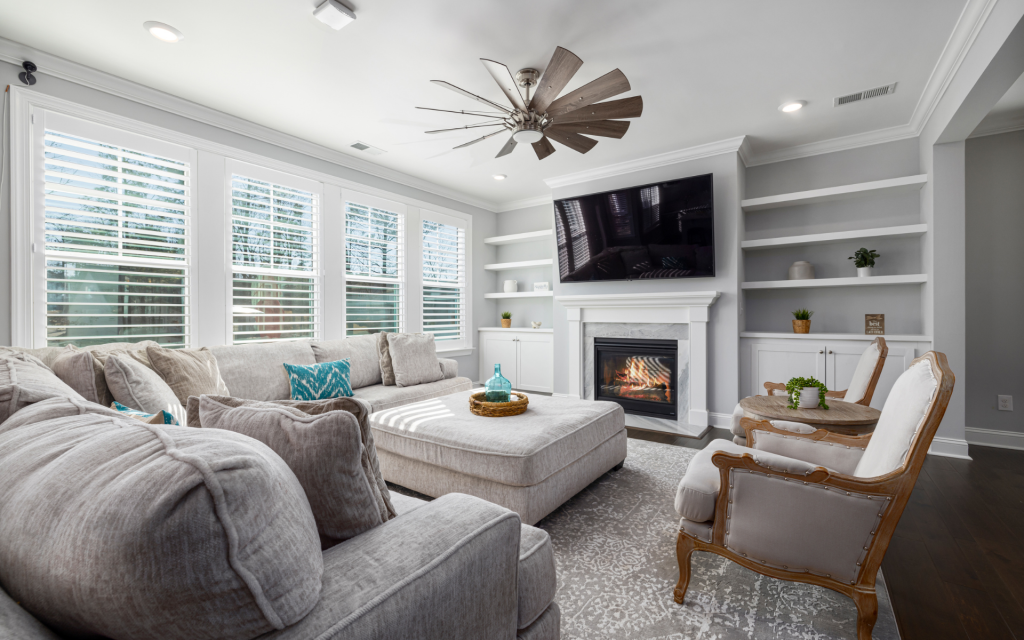
Most homeowners in York County use the ceiling fan as the primary light source for the room. You have two main options:
- Integrated LED Kits: These built-in lights offer a sleek, low-profile look. Many are “dimmable” and allow you to change the color temperature (Kelvins) from warm white to daylight.
- Universal Light Kits: Some fans come without lights but are “light kit adaptable,” allowing you to choose a separate fixture that matches your room’s decor.
Pro-Tip: If the fan is your main light source, ensure it produces at least 800 to 1,200 lumens to avoid a “cave-like” feel in your room.
Step 6: Control Options and Smart Home Integration
The days of fumbling for a pull chain in the dark are fading. Modern fans offer sophisticated control methods:
- Remote Controls: The most popular option, allowing you to change speed and light levels from your bed or sofa.
- Wall Switches: Dedicated switches that control the light and fan independently without the need for two separate pull chains.
- Smart Fans: These connect to your Wi-Fi and can be controlled via smartphone apps or voice assistants like Alexa and Google Home. You can even set schedules so the fan turns off when you leave for work in the morning.
Energy-efficient wiring upgrades not only save money but also make your Fort Mill home more attractive to buyers. According to the U.S. Department of Energy, energy-efficient homes typically sell faster and for more money than those without upgrades.
The Importance of Professional Mounting and Safety
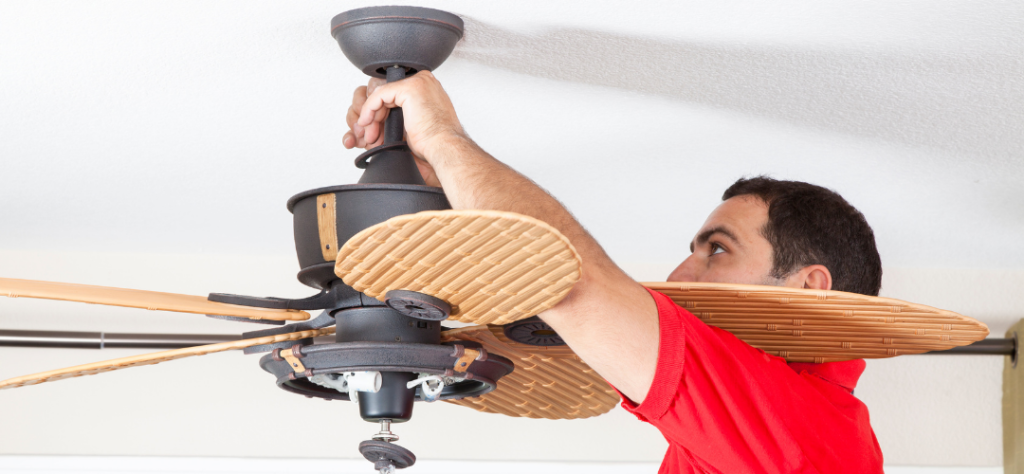
Installing a ceiling fan may seem like a simple weekend project, but it involves working with overhead wiring and heavy mechanical loads.
Why hire a professional in Fort Mill?
- Box Verification: We ensure your electrical box is fan-rated and securely attached to the structure.
- Balancing: A professional will perfectly balance the blades to prevent the annoying “click-click-click” sound and wobbling.
- Correct Wiring: We ensure the grounding is perfect and that the connections are safe from heat and vibration.
- Blade Height: We verify that your fan meets the minimum 7-foot safety clearance, protecting tall family members and guests.
Note: Always ask for an upfront estimate. A reputable electrician will provide a clear explanation of the work required and the associated costs before starting, so there are no surprises.
Stay Cool and Comfortable This Season
Choosing the right ceiling fan is an investment in your home’s efficiency and your family’s comfort. From selecting the perfect blade span to ensuring a rock-solid, professional installation, every step matters. Don’t let the South Carolina humidity get the best of you this year. Upgrade your home with a fixture that provides the perfect breeze and complements your style.
Ready to upgrade your comfort? Contact Johnathon Brown Electric today for expert ceiling fan selection advice and professional installation in Fort Mill, SC, and surrounding areas. Our team will ensure your new fan is safe, silent, and perfectly suited for your space.
Ceiling Fan Selection FAQs
In the summer, your fan should spin counter-clockwise to push air down and create a breeze. In the winter, you should reverse it to spin clockwise at a low speed; this pulls cool air up and pushes the warm air trapped at the ceiling back down to the floor.
Not necessarily. The number of blades is mostly an aesthetic choice. A 3-blade fan often moves air more efficiently (due to less drag), while a 5-blade fan tends to be quieter. The motor quality and blade pitch are more important than the number of blades.
No. Indoor fans are not “Damp Rated” or “Wet Rated.” The humidity in Fort Mill will cause indoor fan blades to warp (droop) and the motor to short circuit. Always look for a UL-Listed Outdoor rating for patios and porches.
Wobbling is usually caused by unbalanced blades or a loose mounting bracket. While you can use a balancing kit, it is often a sign that the fan wasn’t mounted to a fan-rated box. A professional inspection is recommended.